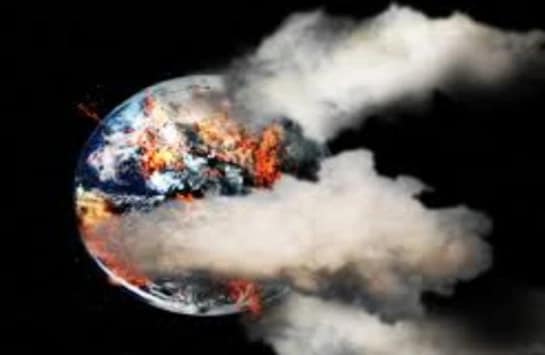
Nuclear War: Only Two Countries Might Survive – A Terrifying Report
I don’t think any of us want to test this out for ourselves. But I came across a new report on nuclear war and its consequences, and honestly, it left me feeling pretty uneasy.
The Mirror wrote about a scientific modeling study that simulated what would happen if the roughly 12,000 nuclear warheads that exist today were ever used in a full-scale global nuclear war scenario.
The explosions themselves would be horrifying — fireballs reaching 100 million degrees Celsius, instantly vaporizing millions. But according to researchers, the real nightmare wouldn’t be the blasts — it would come afterward.
Annie Jacobsen, author of the book Nuclear War: A Scenario, explained it in detail: soot and ash from burning cities would rise into the atmosphere and block out the sun for years — maybe even a decade.
That’s what scientists call nuclear winter. Temperatures would drop dramatically worldwide. Places like Iowa, which produce a huge amount of the world’s food, would be buried in snow and become useless for agriculture. Global famine would follow, and it would kill far more people than the initial explosions.
Jacobsen’s estimate is grim: about three billion people might survive the blasts… but their lives would be unrecognizable. Underground shelters, constant darkness, ozone depletion, radiation, fighting over scraps of food. Not the post-apocalypse we see in movies.
But the part that really stopped me for a moment was this: according to the modeling, only two countries have a realistic chance of making it through with some kind of functioning society — Australia and New Zealand.
Why them? They’re geographically far from the main nuclear powers, so they’re unlikely to be primary targets. They have the ability to grow food even in colder conditions, and their populations are relatively small and spread out. But even there, life wouldn’t be easy. People would have to live underground, deal with radiation, and basically start over.
This is based on serious research — studies from Rutgers University (Alan Robock and team), Toon et al. on nuclear winter effects, and Jacobsen’s analysis of declassified data. It’s not fiction. It’s what the models show.
I read this and just sat there for a minute. We like to think “it’ll never happen,” but when experts lay out the numbers and say only two countries might survive… it hits hard.
Maybe it’s just a reminder to appreciate what we have right now. Because if things ever go that far, there won’t be much left.
Sources: Annie Jacobsen, Nuclear War: A Scenario (2024). Rutgers University nuclear winter research (Alan Robock et al.) Toon et al., nuclear winter studies (various papers, 2007–2020) The Mirror coverage (2025–2026).
I previously wrote about Asteroid 2024 YR4 and its chances of impacting the Moon in 2032. The James Webb Space Telescope has added the final missing piece to this puzzle.